

The right cardio machine can be a poor home-gym choice if its power and clearance requirements don’t suit the room. while some climbing machines need careful placement and overhead clearance. Choosing performance cardio equipment starts with the space and its electrical setup, as well as the workout you want.
It’s natural to focus first on calorie burn, training feel, or the machine that best suits your routine. This guide compares treadmills, ellipticals, bikes, rowers, and stair climbers by calories, impact, space, and user needs, then outlines the practical installation considerations to weigh at home. You’ll have a clearer way to match the equipment to both your training goals and your room.
Key Takeaways
- Match the machine to the training you enjoy and the metrics you’ll use to track progress.
- Compare calorie estimates carefully: effort, body weight, and workout duration all shape the result.
- Choose based on impact, available floor space, and who will use the equipment at home.
- Plan for electrical access, placement, and ceiling clearance before deciding where a machine will go.
Treadmills, ellipticals, bikes, rowers, and stair climbers
For athletic performance, the right machine depends on your sport and training goals. Treadmills support pace-focused running, while rowers and bikes suit power intervals. Compare workout metrics, movement patterns, and setup needs to narrow your options.
Cardio machine options
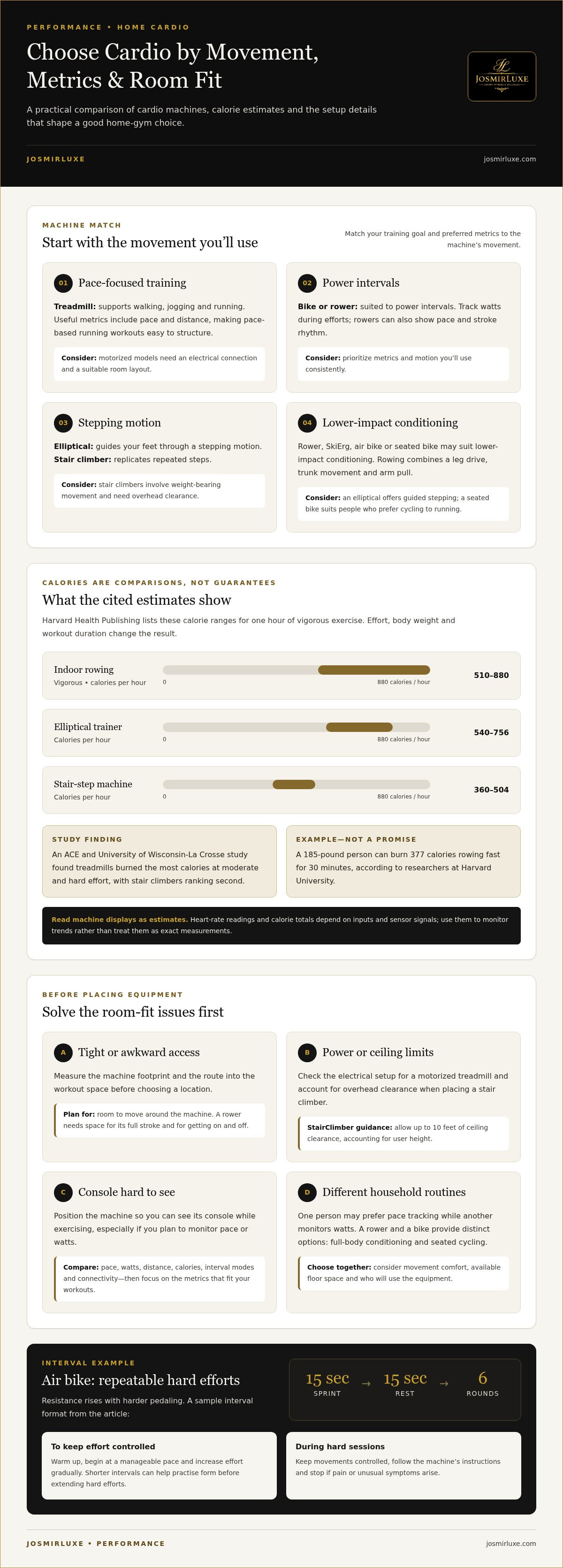
Treadmills are designed for walking, jogging, and running; ellipticals guide your feet through a stepping motion. Bikes allow seated or upright cycling, rowers combine leg drive with an upper-body pull, and stair climbers replicate repeated steps. Compare pace, watts, distance, calories, interval modes, and connectivity to find metrics that suit your workouts. Rowers, SkiErgs, and air bikes are commonly used for lower-impact conditioning, while curved treadmills and stair climbers involve more weight-bearing movement.
Treadmill power and running mechanics
Before placing a motorized treadmill, account for its electrical connection and the room layout. Stair-climbing machines also need overhead planning: allow up to 10 feet of ceiling clearance for a StairClimber, accounting for user height. A curved treadmill uses the runner’s movement to drive its belt; changing position on the curve helps adjust running pace without relying on a preset motor speed.
Machines for athletic performance
Choose a machine that matches the movement you want to train. A treadmill makes pace-based running workouts easy to structure, while a bike or rower lets you track watts during intervals. For example, runners can compare pace and distance, while rowers can monitor power and stroke rhythm. As training volume increases on indoor decks, staying consistent also relies on recovery habits, including nutritional support like magnesium for runners to ease muscle tightness. Ellipticals and stair machines offer distinct stepping patterns, so consider which movement best supports your goals. Prioritize the metrics and motion you’ll use consistently.
Which cardio machine burns the most calories?
A study by ACE and the University of Wisconsin-La Crosse found that treadmills burned the most calories at moderate and hard effort, with stair climbers ranking second. For HIIT, an air bike or rower can support repeatable hard efforts and recovery intervals.
Calories by machine and intensity
Calorie burn changes with body weight, effort, and workout duration, so estimates are comparisons, not personal guarantees. Harvard Health Publishing lists 510-880 calories per hour for vigorous indoor rowing, 540-756 for elliptical trainers, and 360-504 for stair-step machines. A 185-pound person can burn 377 calories rowing fast for 30 minutes, according to researchers at Harvard University. A machine’s calorie display is an estimate; heart-rate readings and calorie totals depend on inputs and sensor signals, so use them to monitor trends rather than treat them as exact measurements.
Rowing and upper-body conditioning
Rowing coordinates a leg drive, trunk movement, and arm pull, making it a full-body conditioning option. Harvard Health Publishing’s vigorous-rowing estimate spans 510-880 calories per hour, reflecting how effort changes energy use. SkiErgs provide another upper-body-focused option, while air bikes combine arm and leg work. In fitness facilities, a mix of cardio machines can serve different training preferences; expected user volume and the desired workout experience help guide the selection.
Equipment for intervals and HIIT
An air bike suits short, intense efforts because resistance rises with harder pedaling. One example is 15 seconds of sprinting followed by 15 seconds of rest, repeated for six rounds. A rower also supports intervals through pace or watt targets. For connected rowing machines, compare whether the touchscreen presents useful metrics such as watts, pace, and interval settings. Facilities can add equipment in phases as user needs grow; at home, consider which display and workout format will keep intervals easy to follow.
Commercial facilities may combine cardio machines from different brands to create a balanced training floor, then add equipment in phases as their needs change.
Choosing equipment by impact, space, and user type
Choose performance cardio equipment based on movement comfort, room layout, and who will use it. Compare watts, pace, distance, calories, interval modes, and connectivity, then focus on the metrics that support each person’s exercise goals. In a shared home gym, one person may value pace tracking while another prefers monitoring watts.
For lower-impact conditioning, consider a rower, SkiErg, air bike, or seated bike. An elliptical offers guided stepping, while a seated bike suits people who prefer cycling to running. These options are not a substitute for individual rehabilitation needs, which depend on the person and their training plan. For example, someone rebuilding endurance may prefer controlled efforts over fast intervals.
Before choosing performance cardio equipment, measure its footprint and the route into your workout space, then leave room to move around it. A rower needs space for the full stroke and for getting on and off; a stair climber also needs overhead clearance. Check that you can see the console while exercising, especially if you plan to monitor pace or watts.
Fatigue during high-intensity sessions can affect technique, particularly during repeated sprints on stair climbers or air bikes. Warm up, start at a manageable pace, and increase effort gradually. Keep movements controlled, follow the machine’s instructions, and stop if pain or unusual symptoms arise. Shorter intervals can help you practise form before extending hard efforts.
For a household with varied preferences, pairing a rower for full-body conditioning with a bike for seated cycling offers two distinct workout options. If lower-impact exercise or rehabilitation is a priority, choose movement that feels manageable and follow an appropriate training plan. For those who also want to extend their low-impact cycling routine outdoors, retailers such as Sherwood E-Bikes Ltd. offer electric bikes that let riders adjust assistance to match their fitness goals.
JOSMIRLUXE: Luxury Treadmills
JOSMIRLUXE offers luxury treadmills for runners who value pace-focused workouts. Before choosing one, compare its intended use with your available floor space, electrical setup, and preferred training metrics. These practical details help determine whether a treadmill suits both your home and your routine.
For workouts beyond running, premium rowing and cardio equipment can support varied conditioning, while functional trainers and strength equipment add resistance training. Smart home gym systems offer another option for a broader training setup. The right combination depends on how you plan to use your space and which forms of exercise you’ll return to consistently.
Explore JOSMIRLUXE performance cardio equipment to consider options for your home gym.
Build a Home Gym Around Your Training
A considered home gym can adapt as your routine changes. Let your current priorities guide your first choices, while leaving room to adjust the setup as your training develops. This makes performance cardio equipment part of a lasting fitness environment, rather than an isolated purchase.
When you’re ready to explore what could suit your setup, browse the options at JosmirLuxe.
Choose a setup that makes it easier to stay consistent, then build from there with confidence.
Frequently Asked Questions
Are there power or installation considerations for cardio machines?
Yes. Electrical supply, access routes, floor placement, and overhead clearance can affect installation. Standard commercial motorized cardio decks require a dedicated 120-volt, 20-amp circuit. Before choosing a location, measure doorways and the intended space, then plan cable access and safe movement around the machine. For a home installation, have a qualified electrician assess the circuit if you’re unsure it meets the equipment requirements.
How do I compare different cardio machine product lines?
Compare machines by intended training, available metrics, console design, footprint, and movement. If you plan to do intervals, look for clear pace or watt displays and straightforward controls. For shared equipment, consider whether the adjustments and interface suit each user. A feature is useful when it supports a training habit you can maintain.
How do treadmills, rowing machines, air bikes, and ellipticals compare for cardio training?
Treadmills suit running-focused sessions; rowers combine leg drive, trunk movement, and arm pull. Air bikes use both arms and legs, with effort rising as you pedal harder. Ellipticals guide your feet through a stepping motion. Choose a treadmill to practise running pace, or a rower for coordinated full-body conditioning. The best fit is the movement you prefer to repeat.
How should cardio equipment be maintained and serviced?
Follow the manufacturer’s care instructions for your machine, since cleaning and inspection needs vary by design. Wipe sweat from contact surfaces, keep the surrounding area clear, and check for visible wear on moving parts, cables, or pedals. If a machine develops unusual noise, feels unstable, or operates inconsistently, stop using it and arrange an assessment by a qualified service professional before using it again.