

A compact sauna can still place a meaningful demand on your home’s electrical system. Home sauna electrical requirements vary by type: many small infrared models use 120V power, while traditional electric saunas commonly require a dedicated 240V circuit. The heater’s wattage and the model’s specifications determine the circuit capacity needed.
Before choosing a sauna or planning where it will go, understand the electrical setup it needs. This guide explains how voltage, wattage, and amperage differ among sauna types, what to consider for a small infrared model, and why the heater rating and installation conditions matter when assessing your home’s electrical supply.
Key Takeaways
- Small infrared saunas often use 120V power, but their circuit needs depend on the unit’s electrical specifications.
- A dedicated circuit may be needed, and some jurisdictions require a disconnect within sight of the sauna.
- Heat, moisture, and outdoor placement affect electrical planning, so wiring and controls need to suit the installation environment.
- Traditional electric saunas commonly use 240V; compare voltage, wattage, and amperage by heater type before choosing a model.
Do small infrared saunas need special wiring?
Often, yes. A small infrared sauna may use 120V, while larger infrared and traditional electric models commonly need 240V. Planning home sauna electrical requirements begins with the heater specifications, then matches them to the supply and circuit.
Dedicated Circuits and Safety Connections
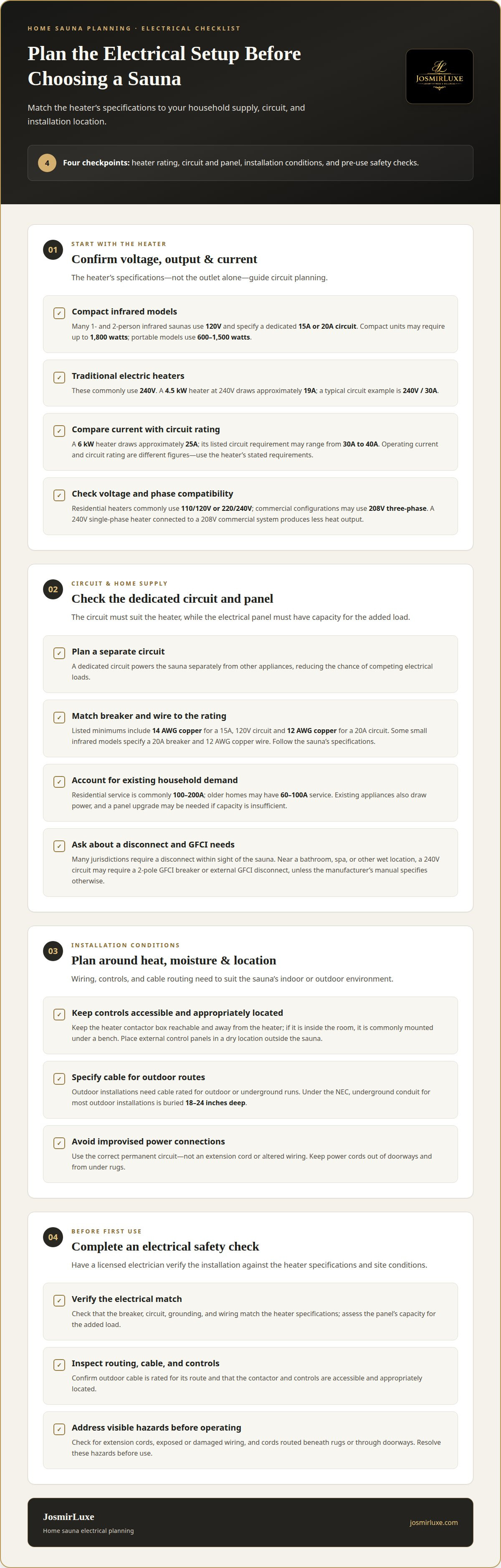
A dedicated circuit powers the sauna separately from other appliances, reducing the chance of competing electrical loads. Many 1- and 2-person infrared saunas use 120V and specify a dedicated 15A or 20A circuit. Grounding connects the equipment to the electrical system’s grounding path. In many jurisdictions, a disconnect switch must be within sight of the sauna, so its location matters in indoor and outdoor plans.
Circuit Sizing and Heater Ratings
Circuit sizing matches the heater’s kilowatt rating and amperage to its breaker and wire. Some small infrared models specify a 20A breaker and 12 AWG copper wire. Listed minimums include 14 AWG copper for a 15A, 120V circuit and 12 AWG for a 20A circuit. Larger infrared units and traditional electric heaters may use 240V; the heater’s specifications determine the suitable circuit rating and wiring.
Electrical Panel Capacity
A dedicated sauna circuit draws power from the home’s electrical panel, so available capacity matters alongside circuit sizing. Residential service is commonly 100-200A, while older homes may have 60A-100A service. A larger heater adds demand alongside existing appliances. A licensed electrician can assess whether the panel can support the added load and whether the proposed circuit matches the sauna’s rating before installation.
Sauna Electrical Requirements: What’s Required?
Heat, moisture, and location affect wiring choices for indoor and outdoor saunas. A licensed electrician can match the installation to the heater rating and the manufacturer’s instructions.
Avoiding Unsafe Wiring Changes
Sauna wiring should use the correct permanent circuit, not an extension cord or improvised modification. Extension cords can create an unsuitable connection for a heater’s electrical demand, while altered wiring may not match its specifications. Keep power cords out of doorways and from under rugs. For an indoor sauna near a bathroom, spa, or other wet location, a 240V circuit may require a 2-pole GFCI breaker or external GFCI disconnect, unless the manufacturer’s manual specifies otherwise.
Wiring Locations and Clearances
Wiring locations and clearances keep controls accessible while limiting exposure to heat and moisture. Place the heater contactor box where it remains reachable; if it sits inside the room, mount it away from the heater, commonly under a bench. External control panels belong in a dry location outside the sauna. For outdoor installations, use cable rated for outdoor or underground runs; underground conduit for most outdoor installations is buried 18 to 24 inches deep under NEC. A sauna disconnect is required within sight in many jurisdictions.
Panel Upgrades and Installation Costs
A dedicated circuit adds demand to the electrical panel, while existing appliances also draw power from it. A panel upgrade may be needed if the panel cannot support the added circuit. An electrician can assess the existing load and installation conditions.
Pre-Use Electrical Safety Checks
Before first use, have a licensed electrician check that the breaker, circuit, grounding, and wiring match the heater specifications. Confirm that outdoor cable is rated for its route and that the contactor and controls are accessible and appropriately located. Check for extension cords, exposed or damaged wiring, and cords routed beneath rugs or through doorways. Address these hazards before operating the sauna.
Voltage, wattage, and amperage requirements by sauna type
Voltage and heater output help distinguish compact infrared cabins from traditional electric saunas. Before planning installation, compare the unit’s rating with your home’s supply and circuit.
Traditional Sauna Electrical Needs
A traditional electric sauna uses a heater sized for the room and a matching electrical circuit. A 4.5 kW heater operating at 240V draws approximately 19A; a typical circuit example is 240V and 30A. A 6 kW heater draws approximately 25A, while its listed circuit requirement may range from 30A to 40A. These figures describe different things: operating current and circuit rating. A licensed electrician can match the wiring and breaker to the heater specifications and household supply.
Infrared Cabin Voltage and Amperage
Infrared cabins span household 120V models and larger units designed for 240V. A 1.8 kW sauna heater on 120V draws approximately 15A, illustrating how output affects current demand. Compact infrared saunas may require up to 1,800 watts, while portable models use 600-1,500 watts. Larger infrared cabins can have higher power needs, so the outlet alone does not establish suitability. The manufacturer’s voltage and amperage rating should guide circuit planning.
Sauna Heater Voltage and Phase Options
Residential sauna heaters commonly use 110/120V or 220/240V, while commercial configurations may use 208V three-phase power. A 240V single-phase heater connected to a 208V commercial system produces less heat output, so voltage compatibility matters. Traditional saunas generally use higher-output heaters than compact infrared cabins. Before choosing a heater, compare its voltage, phase, kilowatt rating, and required circuit with the available supply. A licensed electrician can assess that match and the installation’s wiring needs.
JosmirLuxe: Premium Home Saunas
JOSMIRLUXE offers premium home saunas and infrared sauna options for a thoughtfully planned wellness space. Use the electrical details above to narrow your options: compare each sauna’s voltage, wattage, and amperage specifications with your household supply and intended location. Compact infrared models and traditional electric saunas can have different circuit needs, so the right fit depends on the experience you want and your room’s electrical capacity.
For a broader home training environment, JOSMIRLUXE also offers Luxury Treadmills and Functional Trainers and Strength Equipment. If you’re considering a sauna for your home, contact JOSMIRLUXE to explore the options.
Plan a Sauna That Fits Your Home
Start with the sauna experience you want, then consider where the unit will go, how you’ll use the room, and how it fits into your wider wellness space. Include home sauna electrical requirements in your early planning, alongside the equipment specifications and intended room layout. A considered plan helps you integrate a sauna with other elements of a home wellness space, such as training and recovery equipment.
JosmirLuxe offers Premium Home Saunas alongside Luxury Treadmills, Functional Trainers and Strength Equipment, and Smart Home Gym Systems. To discuss sauna options for your home, contact JosmirLuxe. Take the next step at your own pace, with the details that matter to your space and routine in view.
Frequently Asked Questions
Can I plug my sauna into a regular outlet?
Only if the sauna is designed for that outlet’s voltage and circuit capacity. A standard-looking receptacle doesn’t establish that the circuit can support the heater’s load or that it’s dedicated. For example, JosmirLuxe’s listed infrared sauna models use 120V, with model specifications of 1,660W / 1,820W and 15A / 20A. Match the exact unit’s requirements to the outlet and circuit before use.
120V vs 240V Home Sauna: Which Is Right for You?
Choose based on the sauna type, heater rating, and available electrical supply. A 120V infrared cabin may suit a household seeking a smaller unit, while traditional electric heaters commonly use 240V for higher output. JosmirLuxe’s listed infrared sauna models use 120V. Compare the specific model’s power and current requirements with your intended location, rather than choosing voltage by sauna size alone.
Can I do the wiring myself?
Have a licensed electrician handle sauna wiring, especially work involving a new circuit, grounding, or a breaker. A plug-in connection does not make every part of the installation a DIY task: the circuit still needs to match the heater rating and your home’s electrical capacity. Do not extend cords or modify wiring to make a sauna work with an unsuitable outlet.
Can Your Standard Household Support This?
Possibly, but the home’s service rating alone doesn’t show how much capacity remains. Existing appliances, heating equipment, and the sauna all contribute to total demand. A household with a 120V infrared sauna may have different planning needs from one adding a higher-output 240V heater. An electrician can assess the panel’s available capacity and whether the proposed circuit fits the home’s overall load.
Can a 240V/1PH sauna heater be wired to a commercial building with a 208V system?
It can generally connect to a 208V three-phase commercial system using the L1 and L2 hot wires, but the voltage difference affects heater output. A 240V/1PH sauna heater on that 208V system has 25% less power output. That reduction may change heating performance, so the electrician should assess compatibility with the heater’s specifications and the building’s supply before connection.