

Could a far infrared sauna for home bring a more considered wellness ritual into your space without requiring a complex setup? The right choice depends on more than appearance: infrared models warm the body directly, and many indoor options operate at about 120 to 150°F. Electrical needs vary too, with many models using a standard 120V, 15A outlet and larger units potentially requiring 220V.
The appeal is clear: a home sauna can create a dedicated place to unwind, but its size, capacity and power requirements need to suit the room and household. This guide explains how far infrared heating works, what to understand about electrical setup, and how to compare compact, shared-use and larger home models. You’ll have a clearer framework for choosing a sauna that fits both your space and your daily routine.
Key Takeaways
- Understand how infrared heating differs from a traditional sauna and what that means for the experience at home.
- Match the sauna’s electrical requirements to the outlet and circuit available in your intended room.
- Choose a model by considering its capacity alongside the space you can dedicate to it.
- Keep session guidance in mind: Harvard Health Publishing advises limiting sauna sessions to no more than 15-20 minutes.
What Is an Infrared Sauna?
Infrared saunas use heaters to deliver radiant warmth rather than steam to heat the room. That difference affects the atmosphere, temperature and features to consider when choosing a model.
At-Home Models and Heating Types
A far infrared sauna for home use has panels designed to emit far-infrared heat. Full-spectrum models combine far-, mid- and near-infrared wavelengths. Compare the heating type, controls and cabin layout, not just the model name.
At-home full-spectrum models vary in design and features. Review the manufacturer’s operating and care instructions before choosing a model for your space.
Comparison With Traditional Saunas
Traditional saunas heat the air, often using a heater and stones; infrared models use radiant panels. Traditional sauna temperatures are described as 160 to 195°F, while indoor infrared models operate at about 120 to 150°F.
The U.S. National Library of Medicine describes infrared saunas as steam-free, with low air temperatures of 40-65°C. Choose between the two based on whether you prefer a hotter, steam-compatible environment or direct radiant warmth.
Benefits and Limitations
Infrared saunas offer a steam-free experience, with lower air temperatures than traditional saunas. This may suit people who prefer radiant warmth, but it does not establish a medical benefit or mean every model is suitable for every user.
Follow the model’s instructions and electrical requirements for setup. Clean the cabin according to its care guidance, and consult a healthcare provider about medical concerns before use.
Temperature and Session Length
Indoor infrared models operate at about 120 to 150°F, but settings differ by model. Start with the manufacturer’s instructions and adjust to personal comfort rather than assuming every sauna uses the same setting.
Harvard Health Publishing advises limiting sauna sessions to no more than 15-20 minutes. Heat exposure can feel different from one person to another; people with medical concerns should consult a healthcare provider before sauna use.
Electrical requirements
Start by matching the sauna’s electrical requirements to the room’s available outlet. Voltage, amperage and the model’s connection instructions all matter when choosing where to place it.
Electrical Setup
Many indoor infrared saunas use a standard 120V, 15A outlet. Some models are described as plugging into a standard 110 V outlet. These figures appear in model requirements, so use the specifications for the exact unit you’re considering.
Some infrared saunas are described as plug-and-play, but that does not replace the model’s electrical instructions. Before choosing a location, compare the outlet type and placement with the sauna’s stated requirements. Don’t assume models with different voltage labels connect in the same way.
Larger infrared sauna models may require a 220 V outlet. That requirement changes which locations are suitable. If the chosen sauna specifies 220 V, plan around that connection rather than expecting a standard outlet to meet the model’s needs.
Power Requirements
Voltage and amperage help describe the electrical supply a sauna uses; wattage describes its power draw. For example, a sauna listed at 1200 W has a stated wattage, but that figure alone doesn’t establish its required outlet. Read the complete electrical specification, including voltage and amperage, together.
Use this sequence to compare a model with your room:
- Note the sauna’s stated voltage, amperage and wattage.
- Identify whether it specifies a standard 110 V or 120V, 15A outlet, or a 220 V connection.
- Match the location to the model’s listed connection and installation instructions.
For a far infrared sauna at home, electrical fit depends on the specific model. Prioritize the manufacturer’s full requirements over a general plug-and-play description.
Far infrared sauna models for home
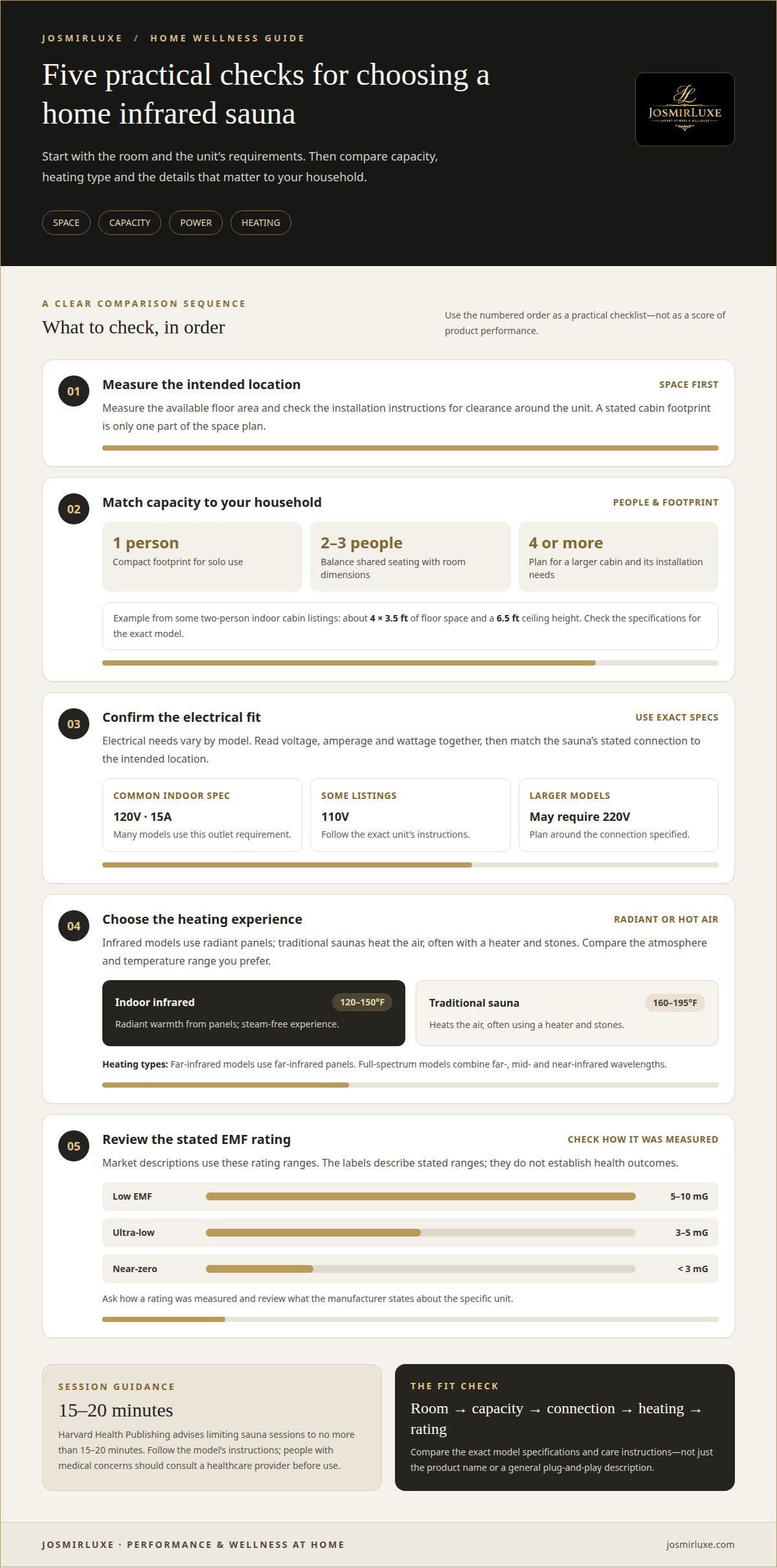
Choose a cabin by matching capacity to your household and available room. Compact one-person models suit solo use; options for two to three people allow shared sessions. Larger cabins accommodate four or more, but need more floor area. Capacity is a useful starting point, not a substitute for measuring.
Some two-person indoor cabin listings give a footprint of about 4 by 3.5 feet and a ceiling height of 6.5 feet; check the specifications for the model you’re considering. Allow space around the unit according to its installation instructions. Setup times vary by model: check the manufacturer’s guidance rather than assuming an indoor infrared cabin will be ready in 15 to 30 minutes or that two people can assemble it in an hour or two.
For a far infrared sauna at home, compare the heater type and the model’s stated electromagnetic-field rating. Market descriptions group low EMF ratings at 5-10 mG, ultra-low at 3-5 mG, and near-zero below 3 mG. These labels describe rating ranges; they don’t establish health outcomes. Review how a rating was measured and what the manufacturer states about the unit.
- One person: prioritize a compact footprint and solo capacity.
- Two to three people: balance shared seating with room dimensions.
- Four or more: plan for a larger cabin and its installation needs.
The practical takeaway: measure the intended location first, then compare capacity, heating type, electrical fit and the model’s stated EMF rating. A well-matched sauna is easier to integrate into your home routine than one chosen by capacity alone.
JosmirLuxe: Premium Home Saunas
JOSMIRLUXE is a natural next step when you’re ready to consider a home sauna. Its Premium Home Saunas and infrared Sauna offerings connect the practical decisions in this guide with options for a dedicated home wellness space.
Use your shortlist to compare capacity, cabin dimensions, electrical requirements and heating type. If a low-EMF rating matters to you, check the specific model’s stated rating rather than assuming all infrared saunas share one. This approach keeps the focus on the details that matter when shopping for a far infrared sauna for home.
For a wider home fitness setting, JOSMIRLUXE also offers Luxury Treadmills and Functional Trainers and Strength Equipment. Contact JOSMIRLUXE to discuss your home sauna options.
Make Your Wellness Space Your Own
Before choosing a far infrared sauna for home use, consider how you want the space to function each day. A quiet retreat, a shared wellness room and a home gym each call for a different setup. Let your preferred routine shape the space so the sauna feels naturally integrated.
A considered wellness space can evolve over time. Keep your priorities clear, leave room for the routines you value, and choose an arrangement that feels comfortable to return to. JosmirLuxe’s perspective on home wellness supports a thoughtful approach to creating a space that reflects your own habits and preferences.
Once you know how you want to use the room, you can choose a setup with greater confidence and make the space your own.
Frequently Asked Questions
What size and electrical requirements do home infrared saunas have?
Dimensions and electrical needs depend on the model. For a far infrared sauna for home use, compare its measurements with the intended room. JosmirLuxe’s one-person model measures 74.4″ H × 33.5″ W × 43.3″ D overall; its two-person model measures 74.4″ H × 45.3″ W × 43.3″ D. The listed sauna voltage is 120 V; use each model’s own electrical specifications.
How much does a home far infrared sauna cost, including installation and operating costs?
The total cost depends on the sauna you choose, delivery conditions and any electrical work needed at home. Running costs vary with the model’s wattage, session duration and your electricity rate. To estimate electricity use, combine the specific model’s wattage with expected usage and your utility rate. Installation costs depend on whether your existing electrical setup meets the unit’s requirements.
What are the best-rated far infrared saunas for home use in the United States?
No single rating establishes the best choice for every household. For a far infrared sauna for home use, compare documented ratings with capacity, dimensions, and electrical fit. JosmirLuxe offers a one-person model, VAS01-Wood, and a two-person model, VAS02-White. Start with who will use the cabin and how it fits the intended room, then consider the ratings published for that specific model.
What materials, heaters, and safety certifications should I look for in a home infrared sauna?
Look for clear descriptions of construction, heater type, and certification documentation for the exact model. JosmirLuxe’s sauna details describe solid Hemlock or oak construction, tempered glass, and six carbon FAR heaters. Its EMF rating of 6 is a technical rating, not a health certification. Treat any safety certification as a separate claim and look for model-specific documentation.
Do home infrared saunas require permits or special electrical work in the United States?
Permit requirements depend on local rules, and electrical work depends on the sauna’s connection and your home’s existing supply. First identify the model’s stated electrical requirements, then compare them with the setup in the intended room. A standard outlet may suit some models, while others may require a different connection. Local building departments determine permit requirements for a specific installation.