

An extendable home sauna is easier to plan when you consider the cabin layout, electrical requirements, and included components together. The right setup depends on the model’s configuration and the space available, so check these details before choosing a place for it at home.
A considered installation starts with practical questions: what needs to be prepared, what electrical supply is required, how long the sauna takes to heat, and what maximum temperature it reaches. This guide explains those factors and clarifies which components to look for, so you can assess the full setup and choose a sauna that suits your home and wellness routine.
Key Takeaways
- Plan the sauna’s placement around its layout and electrical requirements so the installation fits the space and intended setup.
- Compare heat-up time and maximum temperature as separate specifications; both shape how the sauna fits your routine.
- Review the included components before choosing, since they determine what comes with the sauna and what the setup requires.
- Harvard Health Publishing advises limiting sauna sessions to no more than 15-20 minutes; keep session length in mind when planning use.
Installation requirements and electrical supply
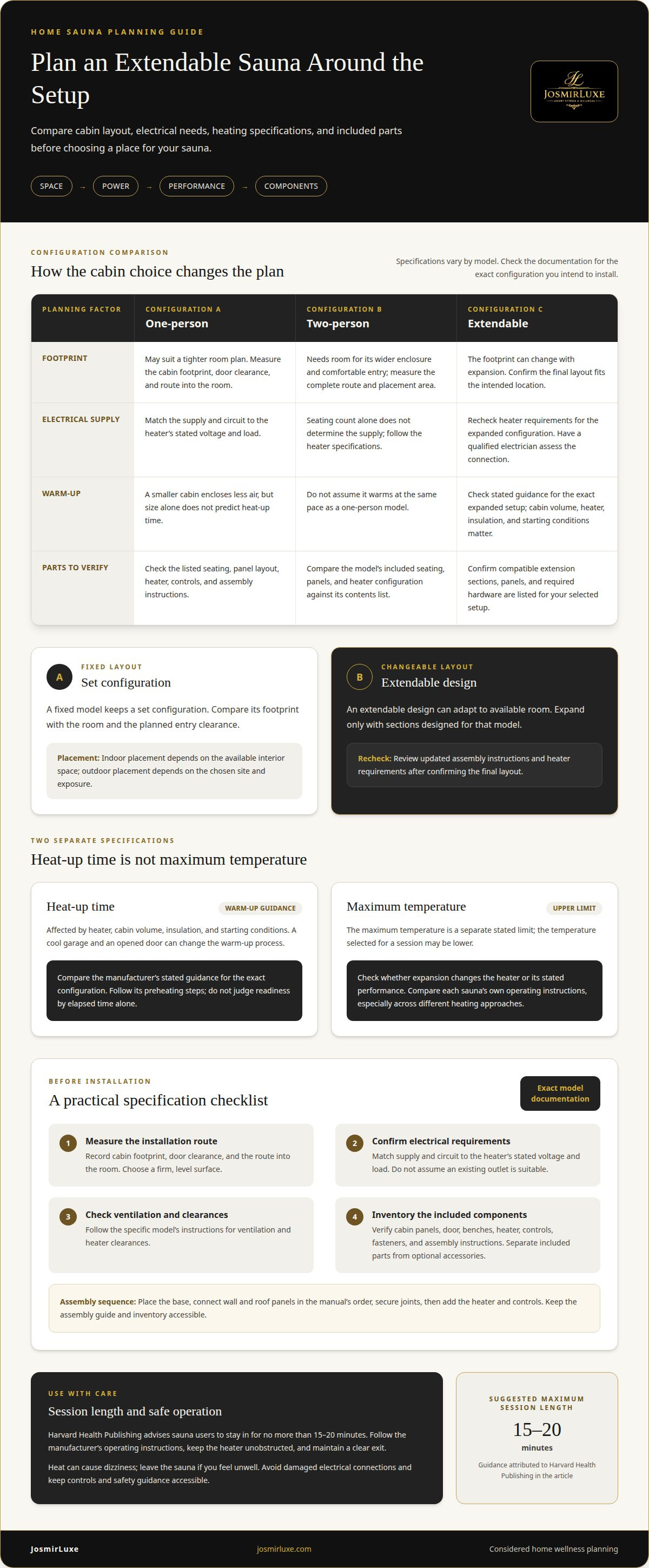
Begin by measuring the sauna footprint, door clearance, and route into the room. A one-person cabin may fit a tighter plan; a two-person layout needs room for its wider enclosure and comfortable entry. Choose a firm, level surface, and keep the location accessible for assembly and routine care. Ventilation and heater clearances must follow the specific model’s instructions.
For assembly, place the base first, then connect the wall and roof panels in the order shown in the manual. Secure each joint before adding the heater and controls. Expand the cabin only with compatible extension sections designed for that model, then review the updated assembly instructions and heater requirements. Maintain it by wiping surfaces as directed, keeping the heater area clear, and inspecting panels and connections regularly.
Electrical supply depends on the heater’s stated voltage and load, not simply on whether the cabin seats one or two people. Match the power supply and circuit to the manufacturer’s specifications, and have a qualified electrician assess the connection. Don’t assume an existing outlet is suitable. A larger or extended configuration can change the equipment requirements, so assess the final layout before installation.
Plan sessions with care: Harvard Health Publishing advises sauna users to stay in for no more than 15-20 minutes. In a study reported by the National Library of Medicine, three of the 22 women lost consciousness during a 20-minute sauna session at 120°C. These findings make clear why correct setup, operating instructions, and controlled session length matter. Before using the sauna, confirm that its panels are secure, the heater is unobstructed, and the controls operate as described in its manual.
Heat-up time and maximum temperature
Heat-up time depends on the heater, cabin volume, insulation, and starting conditions. A one-person sauna usually encloses less air than a two-person model, but size alone cannot predict its warm-up. Heater capacity and construction also matter. Compare the manufacturer’s stated heat-up guidance for the exact configuration you plan to use.
Room conditions affect the time, too. A cabin in a cool garage starts differently from one in a climate-controlled room. If the door opens during warm-up, heat escapes and the process may take longer. Follow the manual’s preheating steps, keep the door closed, and use the built-in controls as instructed. Avoid estimating readiness from elapsed time alone.
Maximum temperature is a separate specification. It describes the upper limit stated for the sauna, while the temperature you choose for a session may be lower. Compare that limit across one-person and two-person configurations, and check whether extending the cabin changes the heater or its stated performance. Don’t assume a larger cabin reaches the same temperature at the same pace.
For a practical comparison, record each model’s cabin capacity, heater details, stated warm-up guidance, and maximum temperature. Then consider how those specifications fit your available time and preferred routine. An infrared sauna and a traditional heated sauna use different heating approaches, so compare each model’s own operating instructions rather than treating their temperature figures as directly equivalent. The best choice is the configuration whose documented performance suits your intended use, not simply the one with the highest temperature figure.
Included sauna components
Compare the itemized contents, not just the cabin dimensions. A one-person and two-person model may differ in seating, panel layout, and heater configuration. For an extendable home sauna, confirm which parts support expansion. The product documentation should identify the cabin panels, door, benches, heater, controls, fasteners, and assembly instructions. Treat each as a checklist item, not an assumed inclusion.
Packaging and setup details matter. Check whether the listed components cover the selected configuration, including any extension panels and required hardware. Separate included parts from optional accessories, such as lighting or additional seating. This distinction helps clarify what arrives and what installation may require. Keep the inventory and assembly guide accessible during setup.
Compared with fixed indoor or outdoor saunas, an extendable design offers a changeable footprint. Fixed models keep a set configuration, while an expandable layout can adapt to available room. Indoor placement depends on the planned interior space; outdoor placement must account for the chosen site and exposure. The useful comparison is how each design fits your space and installation plan.
Total cost depends on the selected sauna configuration, included components, shipping, and installation needs. Expansion parts or additional installation work can affect the final amount, so assess the complete package rather than the cabin alone. No general price applies across different models and delivery arrangements.
Follow the manufacturer’s operating instructions, keep the heater unobstructed, and maintain a clear exit. Heat can cause dizziness; leave the sauna if you feel unwell. Avoid damaged electrical connections and keep the controls and safety guidance accessible during use.
JosmirLuxe: Premium Home Saunas
JOSMIRLUXE’s Premium Home Saunas offer a considered next step for readers comparing a compact solo setup with a shared two-person space. Explore the available sauna options with your room dimensions, preferred layout, and electrical requirements in mind. These details help narrow the choice to a configuration that fits your home and intended routine.
If you’re weighing different heating approaches, JOSMIRLUXE also offers an infrared Sauna. Compare each option’s specifications and included components before deciding, and use the product details to understand how a particular model may suit your space.
For a broader home wellness space, JOSMIRLUXE also offers Luxury Treadmills and Functional Trainers and Strength Equipment. Explore the sauna options and product details on the JOSMIRLUXE website.
Shape a Sauna Space That Fits Your Home
Choosing an extendable home sauna lets you plan a dedicated wellness space around how you intend to use it. Consider how the cabin will fit within your home and whether the surrounding area should remain focused on relaxation or accommodate other routines. JosmirLuxe also offers Luxury Treadmills, Functional Trainers and Strength Equipment, and Smart Home Gym Systems for a broader home fitness setup.
Once you know the space and setup you want, compare the listed sauna models against those priorities. Review the dimensions, temperature range, and electrical requirements to choose an option that fits your home.
Contact JosmirLuxe about your sauna to take the next step toward a wellness space that feels right for you.
Frequently Asked Questions
What is an extendable home sauna and how does it work?
An extendable home sauna is described as using a sliding mechanism to adjust its configuration. JosmirLuxe’s listed one-person and two-person models are described as using FAR infrared heating. Check the product documentation to confirm the heating mechanism, included components, and whether assembly or professional installation is required; these are different tasks. Confirm the model’s dimensions and electrical specifications before deciding whether it suits your space.
What electrical requirements and permits are needed to install a home sauna?
Available listing information gives electrical specifications of 120 V, 1,660 W / 1,820 W, and 15 A / 20 A, but confirm the figures for your selected model in its product documentation. Have a qualified electrician assess any wiring work. Permit requirements depend on local rules and the planned installation; ask your local building department whether the work requires approval before beginning.
What materials, heaters, and temperature ranges are safest and most energy efficient?
Available listing information describes the models as having solid Hemlock wood, six carbon infrared heaters, and an adjustable temperature range of 68 °F - 149 °F. Confirm these details in the product documentation. They do not establish a universal safety or efficiency ranking. Compare the model’s verified power requirements and cabin dimensions, and follow its operating and care instructions.
What are the dimensions, capacity, and expansion options of popular home sauna models?
JosmirLuxe lists one-person and two-person sauna configurations with an extendable design and sliding mechanism. Confirm the mechanism and compare product dimensions and setup requirements to determine which option suits your space.