

A commercial grade treadmill for home needs room to run: most commercial treadmills are at least 20 inches wide, and running surfaces commonly span 20 to 22 inches. That width can feel reassuring at speed, but it also affects how naturally the machine fits your room.
Choosing a premium treadmill means looking beyond a wide deck or an impressive console. Balance running space, footprint, intended use, and budget, especially when the machine is for a home gym rather than a shared facility.
This guide covers what to compare in a commercial grade treadmill for home: running-deck width, commercial-style versus home-focused design, and the factors that affect price. You’ll also learn how to match a treadmill to your space and training priorities, without paying for capacity you won’t use.
Key Takeaways
- Use the running-surface width as a key fit criterion: commercial models commonly offer 20- to 22-inch decks, with wider designs potentially suiting larger runners.
- Compare commercial-style and home-focused models by how you plan to train, the space available, and the features that matter most to you.
- Understand why larger treadmills generally cost more and which design choices can influence your budget.
- Match your treadmill to your training needs and room dimensions before choosing among premium home-gym options.
Commercial treadmill brands and models
Commercial models vary by intended use, drive system, and running features. Listings may state speeds from 0.5 to 16 mph, but these figures are model-specific and should be checked against manufacturer information. Some listings also state an incline of up to 18%. Confirm the specifications for a particular model before comparing running-focused designs with simpler walking machines.
Motor descriptions also differ across models. One commercial treadmill listing states a 3.0 HP double-motor drive and a top speed of 18 km/h; other specifications may describe motors rated at 3.5 to 5.0 horsepower. Treat these as listing claims until confirmed by the manufacturer, and compare the stated motor rating and speed together rather than treating either figure alone as a complete measure of suitability.
How do home treadmills compare with commercial gym treadmills? Home models often prioritize a compact footprint or folding design, while commercial-style machines may have a more substantial running platform. A commercial grade treadmill for home can offer a middle ground, provided its size and features suit your room and routine.
No matter which model you choose, plan for safe placement and maintenance. Put the treadmill on a stable, level surface, and follow the manufacturer’s instructions for cleaning and servicing. Stop using it if the belt slips, the frame shifts, or the power cord appears damaged. Arrange appropriate repairs before using it again.
- For running: Compare deck dimensions, verified speed range, and incline capability.
- For mixed fitness use: Consider whether folding or compact storage matters more.
- For frequent training: Review the drive specification and maintenance guidance together.
Commercial treadmill prices
Commercial treadmill prices reflect more than the motor or console. Larger machines generally cost more, and construction and added features can also affect the price. Compare models designed for similar use before judging value. A lower price may involve trade-offs in size, features, or service terms.
Build a total-cost comparison around the specific model, not its headline price alone. Separate the purchase cost from delivery, assembly, warranty coverage, and ongoing service. For example, a treadmill that needs difficult room access may involve different delivery arrangements than one placed near an accessible entrance. Assembly needs can also depend on the machine and installation scope.
What are the delivery, assembly, warranty, and service costs? They depend on the model, delivery access, assembly requirements, and coverage terms. Treat each as a separate budget line so a bundled figure doesn’t obscure what’s included.
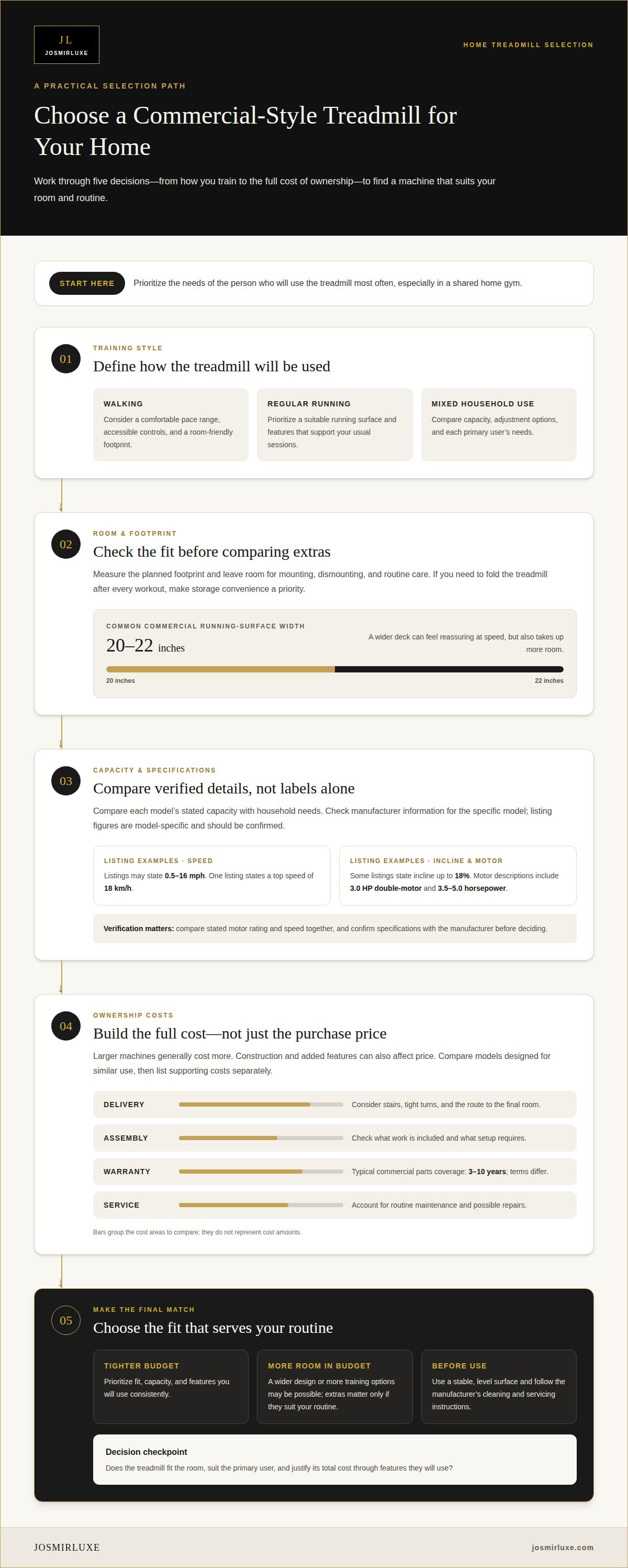
- Delivery: Account for the route into the home, including stairs, tight turns, and the final room location.
- Assembly: Compare the work included with the treadmill’s setup requirements and intended placement.
- Warranty: Typical commercial treadmill warranties include 3-10 year parts coverage, but terms differ.
- Service: Consider routine maintenance needs and how repairs may affect long-term ownership costs.
List the treadmill’s purchase price alongside these four supporting costs. Then weigh the total against features you’ll use, such as incline training or frequent running. This keeps a premium purchase grounded in practical value, rather than a single attractive price.
Commercial treadmill selection for different budgets and needs
Start with three filters: training style, available space, and user capacity. A walker who trains at a steady pace may value compact storage over a wide range of speed options. An interval runner needs a deck and speed range suited to faster sessions. For a shared home gym, prioritize the person who runs most often.
Capacity is another useful comparison point. Compare each model’s stated capacity with your household’s needs and intended training. Don’t assume all commercial machines have identical construction.
Room constraints can change which features are worth paying for. Measure the planned footprint and allow space around the machine for mounting, dismounting, and routine care. If you need to fold the treadmill after each workout, make storage convenience a priority from the start.
- For walking: Focus on a comfortable pace range, accessible controls, and a footprint that suits the room.
- For regular running: Prioritize a suitable running surface and features that support your usual sessions.
- For varied household use: Compare capacity, adjustment options, and the needs of each primary user.
With a tighter budget, prioritize fit, capacity, and features you’ll use consistently. A larger budget may leave room for a wider design or more training options, but extras matter only if they serve your routine. Choose a machine that fits both the space and the person who will use it most.
JOSMIRLUXE: Luxury Treadmills
JOSMIRLUXE offers luxury treadmills for homeowners choosing equipment to suit their training routine and home-gym space. After weighing running area, capacity, and intended use, explore JOSMIRLUXE’s treadmill options to find a suitable fit.
A home setup can bring different types of training together. Pair a treadmill with functional trainers and strength equipment, a smart home gym system, or premium rowing and cardio equipment to create a broader fitness space. The right combination depends on how you train and how much room you want to dedicate.
Start with your priorities: running, walking, shared household use, or a more varied routine. That helps clarify which features deserve your attention as you explore luxury treadmills.
Contact JOSMIRLUXE to discuss your home treadmill needs.
Shape a Home Gym Around Your Routine
Choosing a commercial grade treadmill for home is also a chance to plan beyond the machine itself. Consider how your training habits may change, how you want the room to feel during daily use, and whether the equipment will support a routine you can sustain. A well-planned space makes the treadmill part of a considered fitness environment, not an isolated purchase.
Before you choose, decide what matters most: focused running, flexible training, or a dedicated space for movement at home. Clear priorities make it easier to explore options that fit your goals.
Contact JOSMIRLUXE to discuss home treadmill options, and take the next step toward a gym shaped around your routine.
Frequently Asked Questions
How wide are commercial treadmills?
Commercial treadmill widths vary by model, so check the manufacturer’s running-deck measurement when assessing fit. Consider your natural stride and whether you drift sideways during faster workouts. A deck that feels comfortable on a brief walk may feel different on a longer run, so judge its width against your usual pace and movement.
What brand of treadmills do gyms commonly use?
There isn’t one brand used by every gym. Facilities choose equipment based on their training programs, operating needs, and preferences. A gym’s choice can be a useful reference for a home purchase, but it doesn’t determine what suits your routine. Note which controls and workout functions you prefer, then compare those details across the models you’re considering.
What are the best commercial-grade treadmills for home use in 2026?
The best fit is the model suited to your workouts and the people who will use it. Before deciding, consider who will operate the treadmill, whether the controls are easy to reach, and whether the display is clear from your usual running position. These everyday details can make a machine more practical in a shared home gym.
How much do commercial-grade home treadmills cost in the United States?
Commercial-grade treadmill prices vary by model, so the category alone won’t tell you what you’ll pay. For a useful comparison, separate the equipment price from delivery, setup, coverage, and service costs. Review the purchase terms alongside the machine’s features, and budget for the complete arrangement rather than assuming a category-wide price.
How much space and ceiling height does a commercial treadmill need at home?
The space and ceiling clearance you need depend on the treadmill, room, and user. Consider the entire route from the entrance to the machine’s final position, including doorways and turns, not just the room itself. For ceiling clearance, allow for the tallest user’s headroom while running, particularly during incline workouts. Use the model’s dimensions to guide placement.